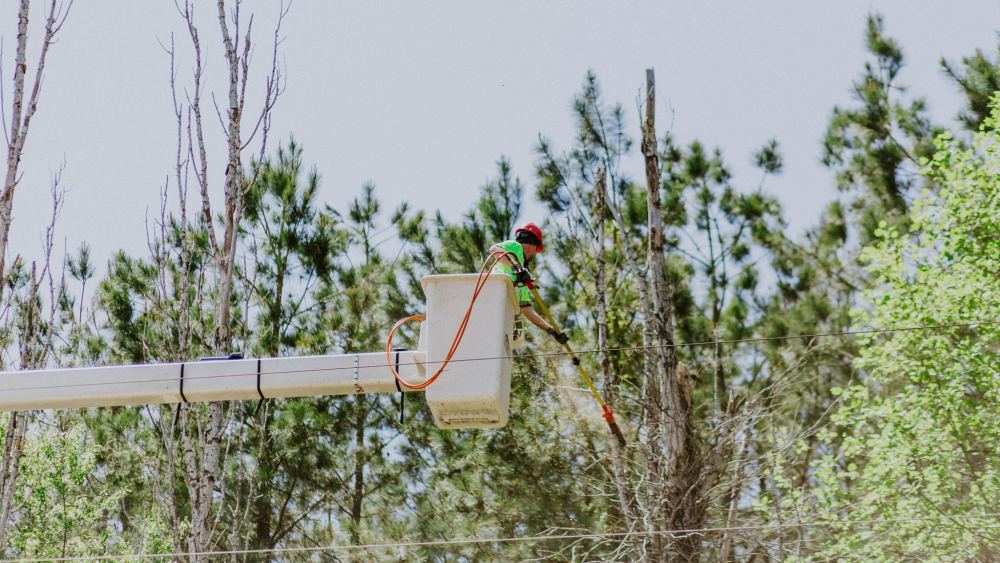
The same trees that define the rural Virginia landscape can also be one of the biggest threats to keeping the lights on if not kept out of contact with power lines. Behind the scenes, REC's year-round vegetation management program works to prevent outages before storms arrive, using data, field observations and targeted pruning to reduce risk along thousands of miles of overhead line.
For REC, the goal isn't just tree trimming. It's a reliability strategy to address the single most common cause of outages on the system. "Because trees cause 70% of our power outages, we approach vegetation management with science, technology, member interaction, effective and long-term vendor partnerships, and communication," said Cindy Devlin Musick, senior director—vegetation management services at REC.
Each year, REC prunes approximately 20% of its 7,500 miles of overhead line. Rights-of-way generally are 40 feet wide. REC selectively follows up the next year with integrated vegetation management to keep the forest floor clear. Environmentally, this creates miles of wildlife and pollinator habitat. Practically, lineworkers can walk safely to perform maintenance or identify storm damage.
"Lineworkers are our eyes in the field. They alert us to trees that could cause outages," Musick said.
Right-of-way management has a direct impact on REC's member-owners, which is why REC responds to every one of the roughly 3,000 annual tree-related inquiries it receives.
"We know trees directly affect electric system reliability, safety, sustainability, member value and customer service levels," Musick said.
But it's not just about responding to reports from the field. REC's foresters identify environmental causes of tree-related outages by examining trees. Satellite data and geographic information system mapping reveal trouble areas. Circuit analytics assess line performance and point crews to where mid-cycle trimming may be required.
Industry leading research has collected 1,200 data points that show potential outage causes on the REC system. "This study is shaping our proactive approach to vegetation management and outage prevention," Musick said.
The statistical review, funded through a $50,000 grant from the International Society of Arboriculture's Tree Fund, is being conducted in collaboration with West Virginia University.